The Complete Aging-in-Place Home Assessment
Most aging-in-place guides hand you a 200-item checklist and a credit card. This is the room-by-room assessment occupational therapists actually use — sorted by what you can fix this weekend, what to invest in this year, and what to bring a pro in for.

Written by
Better Years Editorial TeamThis article contains affiliate links. We may earn a commission if you purchase through our links, at no extra cost to you.
Bottom line Most homes can be made meaningfully safer for an aging parent in a single weekend, for under $400, without a renovation. The rest is a multi-year project — and it should be. This is the room-by-room walkthrough we recommend you do once together, then once a year after that.
Key takeaways
- More than half of older-adult falls happen at home, and most are preventable with three specific fixes: bathroom support, nighttime lighting, and clearing the path between bed and bathroom.
- Sort every modification into four buckets — buy now, handyman, contractor, clinical review — and the project stops feeling overwhelming.
- The bathroom is the single highest-risk room. If you only do one room this year, do that one.
- An occupational therapist's home evaluation can be covered by Medicare Part B with a physician referral. This is the single most underused benefit in the category.
- The goal is not a perfectly retrofitted house. It is the next safe step for the person living there today.
Who this assessment is for
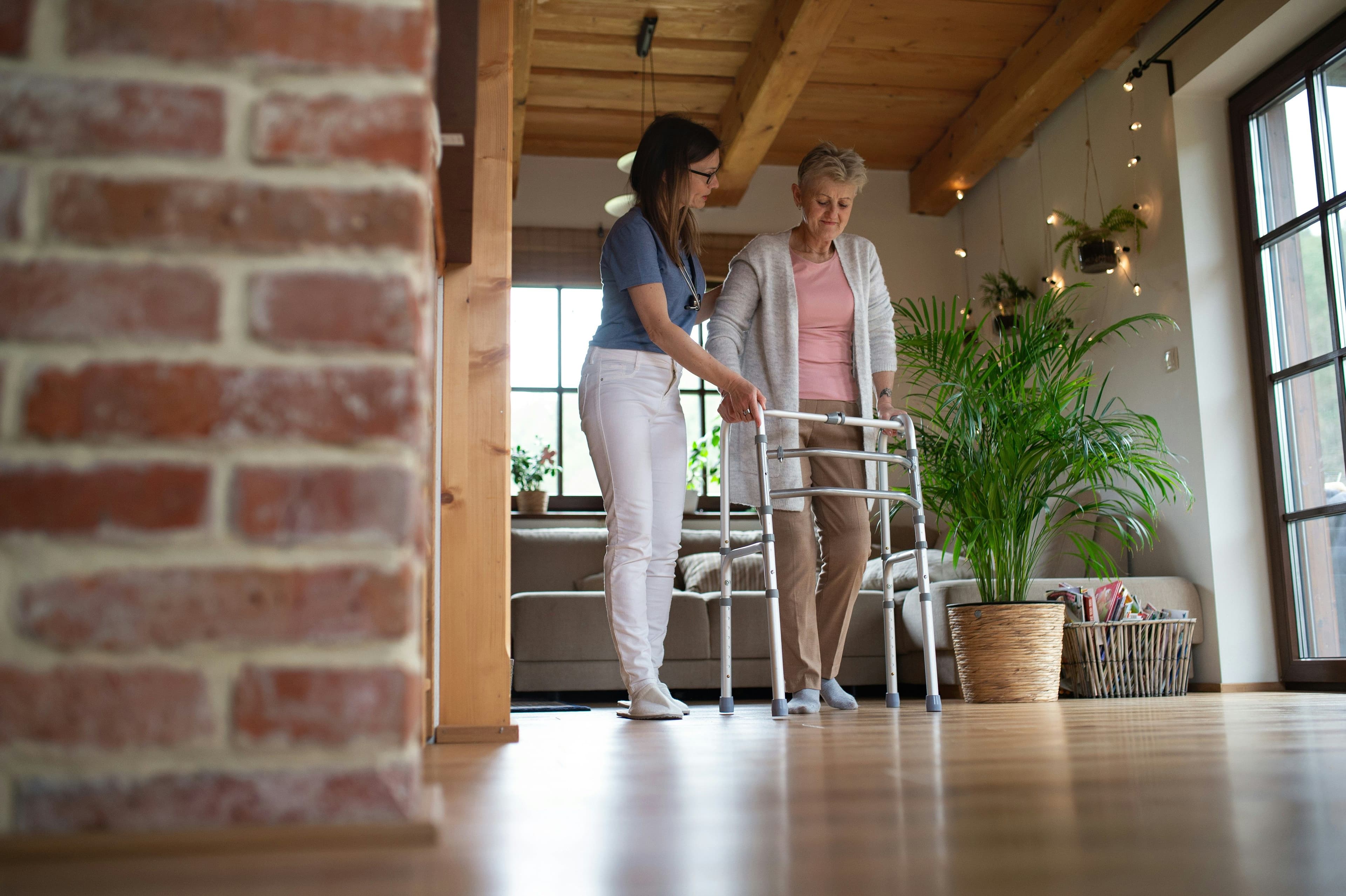
You are probably the adult child, in-law, or close friend who has started noticing things — the cluttered hallway, the bathmat that slides, the burned-out hall light no one has replaced. Your parent insists everything is fine. You are not sure whether you are overreacting or underreacting.
This assessment is built for that moment. It assumes you have between two and four hours to walk the home, a phone for taking notes, and a willingness to involve the person who actually lives there in every decision. It does not assume you have a contractor, a budget, or your parent's full cooperation. Those come later.
The framework comes from how occupational therapists trained at the American Occupational Therapy Association's home-modification level actually evaluate a home: not as a project, but as a conversation between the person, their daily routines, and the physical space those routines move through.
How do you sort everything you find?
Before you walk a single room, agree on the language you will use to label what you find. Every item in this house will fall into one of four buckets.
Buy now. Items you can order today and install yourself or with a screwdriver — non-slip mats, motion-sensor nightlights, a lever doorknob cover, a raised toilet seat, a shower chair. Total spend per item: typically under $50. Total spend per home for the buy-now pass: $150–$400.
Handyman. Items that need two hours of skilled labor and a stud finder — grab bar installation, secure handrails, threshold ramps, swapping out round doorknobs for lever-style hardware, adding under-cabinet kitchen lighting. Total: a $150–$400 half-day plus materials.
Contractor. Items that change the structure of the home — tub-to-shower conversion, stair lift, doorway widening, curbless shower remodel, a permanent exterior ramp. These need a Certified Aging-in-Place Specialist (CAPS) and at least two written quotes. Realistic 2026 spend: $4,500 to $25,000+ depending on scope and metro.
Clinical review. The items that aren't items at all. Gait that's gotten unsteady. A new medication that causes dizziness. Vision changes. Early confusion. These need an occupational therapist, physical therapist, or physician — not Amazon. They show up on the assessment, but the action is "schedule a visit," not "install something."
The single most useful move you can make this weekend is to print this list with five columns — room, hazard, fix, bucket, owner — and walk through the home labeling everything. The list does the negotiating that you and your parent shouldn't have to.
How to do the walk-through
Do it once, together, with the person who lives in the home leading. They walk; you take notes. They name what they're avoiding (the tub they don't feel safe getting out of, the basement steps they've stopped using, the bedside table that's gotten too tall). You write only what they name in the first pass. Then you add what they didn't, with their permission.
Go in the order the person actually moves through the home in a 24-hour day. For most parents this is: bedroom → bathroom → kitchen → living room → entries → outdoor → stairs and basement. Do the walk at the time of day they actually use each room. The 2 a.m. bathroom trip is a different room than the noon bathroom trip.
Room-by-room: what to look for and what to do
The bedroom
What to look for: the path from the bed to the bathroom (any rugs, cords, low chairs in the way?), the height of the bed (can the person sit and place both feet flat on the floor?), the lamp within reach of the bed, and what they wear at night (long robes and loose pajama legs are a common fall cause).
Buy now. Motion-sensor nightlights every six feet along the bed-to-bathroom path. A bedside lamp with a touch switch or a remote. A bed-rail handle that slides between mattress and box spring (no installation).
Handyman. Adjust bed height by adding or removing the box spring or risers so feet land flat. Add a secure handrail if there is a step into the bedroom.
Contractor. Move the primary bedroom to the main floor if it is currently upstairs — the single highest-impact aging-in-place modification a home can undergo.
The bathroom
If you do nothing else this year, do this room. Roughly 28% of bathroom injuries in adults 65+ are toilet-related, and another large share happen entering or exiting the tub. Grab bars at the toilet and inside the shower have been shown to substantially improve balance recovery — the CDC identifies grab bar installation as one of the highest-evidence environmental interventions for fall prevention. We treat this room in depth in The Bathroom: The Most Dangerous Room and How to Fix It, but the essentials:
Buy now. Non-slip mat inside the tub or shower. Non-slip mat outside it. A raised toilet seat with arms (about $40). A handheld showerhead. A waterproof shower chair or transfer bench.
Handyman. Two grab bars installed into studs or solid blocking — one at the toilet, one inside the tub or shower. A handyman who installs into drywall anchors is the wrong handyman. A bar that pulls out under load is worse than no bar at all.
Contractor. Tub-to-shower or curbless-shower conversion. Comfort-height toilet. Widened doorway if a walker or wheelchair is on the horizon.
The kitchen
What to look for: items stored above shoulder height or below the knee, slick floors, a stove the person now avoids, sharp counter corners on the route between sink and table, lighting that's gone dim with age.
Buy now. Step stool removed and replaced with reachable storage. Brightest LEDs the fixtures take. Lever-style faucet handle covers. Anti-fatigue mat at the sink. Brightly colored tape on counter edges that have low contrast with the floor.
Handyman. Under-cabinet LED strip lighting (the single best dollar-for-impact kitchen upgrade for older eyes). Pull-out shelves in lower cabinets. A second handrail if there are any steps into the kitchen.
Contractor. Lowered countertop section for a seated workstation. Induction cooktop if forgotten burners are a concern.
The living room
It surprises most families, but more falls happen here than in the bathroom — simply because more time is spent here. The danger is low chairs that the person struggles to rise from, throw rugs, taped-down extension cords, and a coffee table positioned exactly where a person reaches out to catch themselves.
Buy now. Remove every throw rug. Don't relocate them — remove them. Furniture risers to bring chairs to a height where the person can rise without using their hands. A wedge cushion. A clear path of at least three feet across the room.
Handyman. Bury or rewire extension cords. Add ambient lighting in addition to the one lamp by the chair.
Contractor. None typically.
Entryways and stairs
Look at: the threshold height at every door, handrails on both sides of every stair, lighting at the top and bottom of each flight, and whether the person uses both hands to carry things up and down.
Buy now. High-contrast tape on the leading edge of each step. Motion lights at the top and bottom. A storage tray inside the door so the person isn't carrying groceries up steps.
Handyman. A second handrail on any flight that has only one. Sturdy thresholds replacing any wobbly or sloped ones. A small threshold ramp where there is a single step.
Contractor. Stair lift (a serious quality-of-life unlock for many families). A no-step entry by raising the ground or extending a porch.
The exterior and approach
Look at: the walkway from the car or curb to the door, lighting along it, whether there is a covered place to set things down while unlocking, drainage that creates ice or moss, and a place to sit and rest on the route in.
Buy now. Motion floodlights. A foldable utility cart for groceries. A bench by the door.
Handyman. Repair uneven walkway sections. Add handrail at any porch step.
Contractor. Regrade walkway. Add a permanent ramp if mobility devices are in use.
The thing most home assessments don't tell you
Most aging-in-place pieces are framed as a project. They aren't. They're a process. Matt Haase, an occupational therapist quoted in The New York Times' aging-in-place guide, put it this way: you don't do all of this at once. You start in your forever home before you need it, and you layer in modifications as life signals you to. The Buy-Over-Time Aging-in-Place Shopping List article in this hub walks through that sequencing in detail.
What that means for this assessment: don't try to fix everything you find. Pick the three highest-impact items per room, do those, and re-walk the home in 12 months. Anything that didn't make the top three this year almost certainly didn't matter as much as you thought it did.
Reviewer's note Reviewer's note (CAPS remodeler): The biggest mistake I see families make is starting with the most expensive room — usually a full bathroom remodel — and stopping there because it drained the budget. Start with the buy-now pass across the whole house first. You will prevent more falls in a weekend that way than you would with a six-week renovation.
What it costs in 2026 Realistic 2026 ranges: the buy-now pass across a full home runs $150–$400 in supplies. A handyman half-day to install grab bars, secure handrails, and add lighting commonly runs $150–$400 in labor. A full bathroom safety package (two grab bars installed, raised toilet seat, handheld shower, non-slip surfaces, transfer bench) lands at $400–$1,200 fully installed. Tub-to-shower conversions vary widely by metro: $4,500–$12,000 is common, with high-design coastal markets above that. Stair lifts run $3,500–$5,500 installed for a straight staircase, more for curved.
When should you bring in a professional?
Three signals tell you it is time to involve a credentialed pro, not just a handyman or a checklist:
1. A fall has happened or nearly happened in the last six months. Schedule an OT home evaluation. Medicare Part B can cover this when a physician orders it.
2. Vision, balance, or memory have changed. Add a physical therapist or geriatrician to the team. The fix may not be the home.
3. You are about to spend more than $3,000 on modifications. That is the threshold at which a CAPS contractor's design eye pays for itself. They will catch the doorway that needs to widen later, the floor level that should match the future curbless shower, the blocking that should go in the wall now even if the grab bar comes later.
Download the Better Years Home Assessment Checklist
A printable, one-page version of this walk-through — five columns, every room — designed to be filled out together. (Newsletter signup to receive the PDF.)
Our Top Pick: Amazon Basics 24" Stainless Grab Bar
An affordable, ADA-compliant grab bar rated by over 9,300 buyers, with a 500 lb weight capacity and brushed stainless finish — the single most universally recommended first purchase from any home safety assessment.
View on AmazonFrequently Asked Questions
Sources
- 1.National Institute on Aging — Aging in Place: Growing Older at Home — National Institute on Aging (2024)
- 2.Centers for Disease Control and Prevention — Facts About Falls — CDC (2024)
- 3.American Occupational Therapy Association — Safe at Home Checklist — AOTA (2023)
- 4.National Association of Home Builders — Certified Aging-in-Place Specialist (CAPS) — NAHB (2024)
- 5.AARP — HomeFit Guide — AARP (2023)
- 6.National Council on Aging — How to Prevent Falls with Home Safety Modifications — NCOA (2024)